Product recommendations: turning sales data into relevant suggestions
Product recommendation solutions help guide customers and sales teams toward the most relevant products based on real purchasing behavior. Instead of relying on intuition, recommendations are driven by data: what customers bought in the past, which products are frequently purchased together, and how buying patterns evolve over time.
This approach delivers clear business value:
-
Improved customer satisfaction through relevant suggestions
-
Higher cross-sell and up-sell rates
-
Increased average basket size
-
Reduced sales cycle time for sales teams
Recommendations can be used across channels: at checkout, in digital platforms, or by sales representatives during customer interactions.
How recommendations are generated
Recommendations are based on historical sales data and customer behavior. Different analytical methods can be applied depending on the use case and data maturity:
1. Association Rule Learning (Market Basket Analysis)
This method identifies products that are frequently bought together by analyzing past transactions. For example:
-
Tiles and glue appear together in 25% of all invoices (support).
-
Every tile purchase includes glue (confidence = 100%).
-
Half of glue buyers also purchase tiles.
These insights form the basis for cross-sell recommendations such as suggesting glue when tiles are added to the basket.
2. Recommendation systems
This approach looks at average customer behavior:
Customers are then shown products that people “like them” often buy, making recommendations more relevant and easier to accept.
3. Predictive modeling
Predictive models estimate the likelihood that a customer will buy a specific product, given their previous purchases. This allows for more targeted recommendations and prioritization of products with the highest chance of conversion.
Practical use cases
-
Suggest complementary products at checkout
-
Help sales representatives propose frequently paired items
-
Enable data-driven cross-selling based on actual buying behavior
Output and delivery
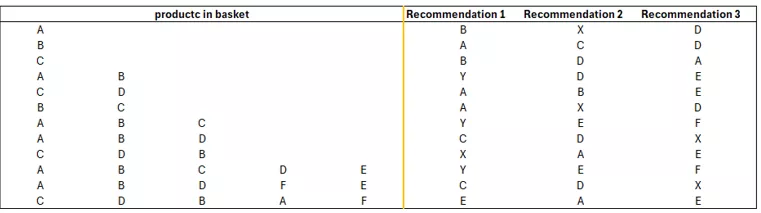
The result is a dynamic recommendation table that lists relevant product combinations and their associated recommendations. This output updates automatically when new orders are placed or when the data is refreshed, ensuring recommendations remain current and accurate.
By grounding product recommendations in real transaction data, organizations can systematically increase revenue while making it easier for customers to find what they actually need.