


Over the past year, I occasionally heard the statement of Claude users: "My Claude agents now have an MCP with direct access to our systems. Soon, we won't need data platforms anymore: I will just query the information there & build a sexy HTML dashboard."
At first glance, that sounds perfectly reasonable. If an AI agent can connect directly to Salesforce, SAP, ServiceNow, Workday, SharePoint, or any other enterprise application, why continue investing in data platforms, warehouses, lake houses, or semantic models? Why move data into a central environment if an agent can simply retrieve it on the spot from where it already lives?
It is an elegant vision, and I understand why it resonates. The idea of leaving data in place, reducing duplication, and allowing intelligent agents to orchestrate access on demand feels cleaner than much of the architecture we have built over the last two decades. And yet, I believe it is based on a fundamental misunderstanding…
The temptation of direct access
People are increasingly connecting their AI tool directly to operational systems through protocols such as MCP & CLI. Data remains where it was created, applications retain ownership of their information, and agents retrieve only what they need when they need it based on the authorisation of the user.
On paper, direct access appears to eliminate much of the complexity that data platforms were designed to solve. There is less data movement, less replication, and potentially less infrastructure to manage. It feels like a natural evolution in a world where AI can reason across multiple systems in real time. However, while this approach addresses access, it does not address the most pressing challenges like understanding, source of truth & performance.
It seems access was never the hardest problem data platforms tried to solve.
Access is not understanding
Technologies such as MCP do significantly reduce the friction of connecting to those systems. An AI agent can now access information that previously required complex integrations or months of development effort. But having access to information is fundamentally different from understanding what that information means. Consider a seemingly simple question: "How many active customers do we have?"
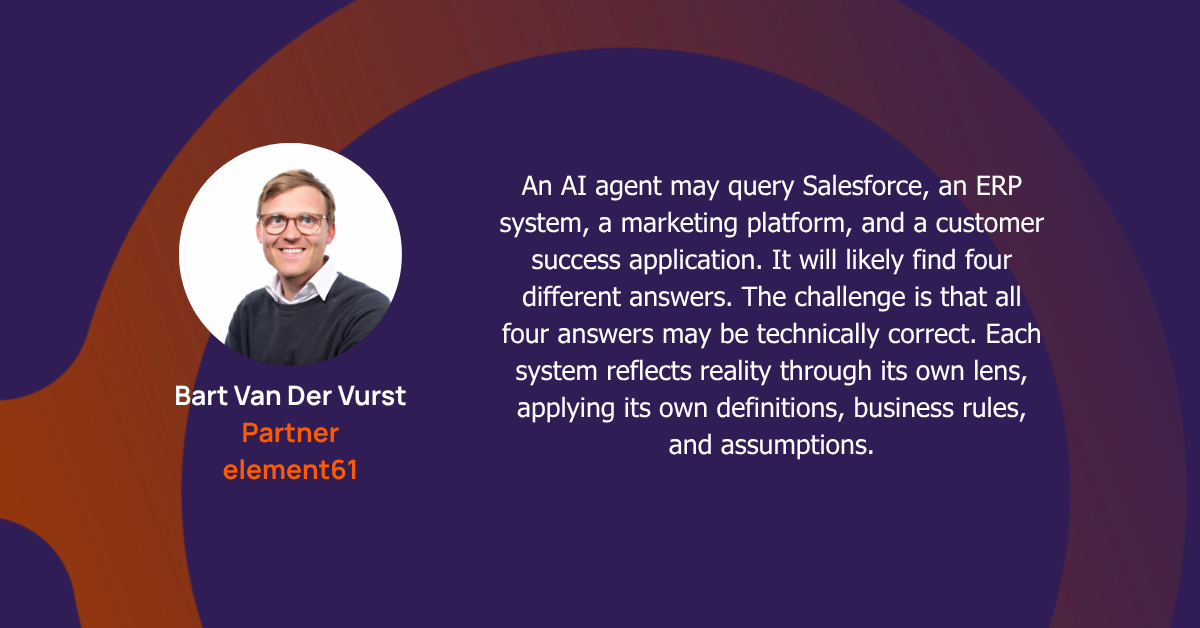
For years, organisations struggled with fragmented landscapes where information was scattered across ERP systems, CRM platforms, collaboration tools, spreadsheets, and countless departmental applications. At that point, the problem is no longer technical. The agent has successfully accessed the relevant information. What it lacks is context. It does not know which definition the organisation considers authoritative, which source should be trusted, or how different interpretations should be reconciled.
The challenge is not data access: the challenge is shared meaning.
The hidden value of the Data platform
This is where I believe many discussions around AI miss the point. We often talk about data platforms as though their primary purpose is to move, store, and process data. While those capabilities are important, they were never the real source of value. The true contribution of a data platform has always been its ability to create a shared understanding of the business.
Over time, organisations embed definitions, business rules, ownership structures, governance processes, quality controls, and trusted metrics into their platforms. What emerges is far more than a technical repository. It becomes a representation of how the organisation understands itself. That work is often invisible because it sits beneath dashboards, reports, and analytical models. Yet it is precisely this layer that allows different teams to align around the same version of reality.
AI is now exposing how valuable that layer truly is. An agent may have access to every system in the company, but that does not mean it understands how the company works.
You cannot outsource your ontology
Interestingly, many technology vendors appear to be arriving at the same conclusion.
Microsoft is investing heavily in semantic models and business knowledge layers (Microsoft’s IQ layers). Databricks is increasingly focusing on governance, business semantics, and unified understanding across data products. Across the industry, the conversation is shifting from data itself toward meaning. And I believe this is exactly the right direction.
However, there is one critical reality that every organisation needs to understand: you cannot outsource your ontology. An ontology may sound like an academic concept, but in practice it is simply the way an organisation defines and connects its business concepts. It describes, for example, what a customer is, how a prospect becomes a customer, which systems contain customer information, which source is authoritative, and how different entities relate to one another.
Imagine an AI agent receiving a question about a customer. The sales opportunity may exist in Salesforce. The signed contract may be stored in SAP. Project documentation could live in SharePoint. Customer interactions might sit in Teams, while billing information resides in a finance system.
The challenge is not finding those assets. Modern technology can already do that. The challenge is understanding that all those pieces belong to the same customer journey and knowing how they relate to one another. That is what an ontology provides.
An ontology acts as the connective tissue between data, systems, processes, and business concepts. It creates understanding without necessarily requiring the underlying data to be physically consolidated into a single platform.
Most importantly, that understanding (that ontology) is unique to every organisation. In my opinion, no vendor can define what a customer means in your company. No vendor can determine which process variations matter, which metrics drive decision-making, or which exceptions have accumulated over years of operating the business.
Your ontology is a company’s intellectual property. In many ways, it represents the digital blueprint of how an organisation actually works.
So, does the Data Platform still exist?
That ultimately depends on how we define the term.
- IF a data platform refers to a centralised environment where all data must physically reside before it can be used, then the answer is NO: this model is undoubtedly evolving. Advances in federation, virtualisation, and AI-driven access patterns are changing how information flows through organisations.
- But IF a data platform is the place where meaning, context, governance, trust, and business understanding come together, then I would argue its importance is only increasing. In fact, we may simply stop calling it a data platform.
The future may look more like a semantic platform. An ontology layer. A business knowledge platform. A context layer that sits above distributed systems and provides a shared understanding for both humans and AI agents.
Because ultimately, people do not ask questions because they want access to data. They ask questions because they want trustworthy answers. And somewhere between access and trust, a new platform is emerging: perhaps the data platform is ending after all but something even more important is being born.
What’s element61’s role in this?
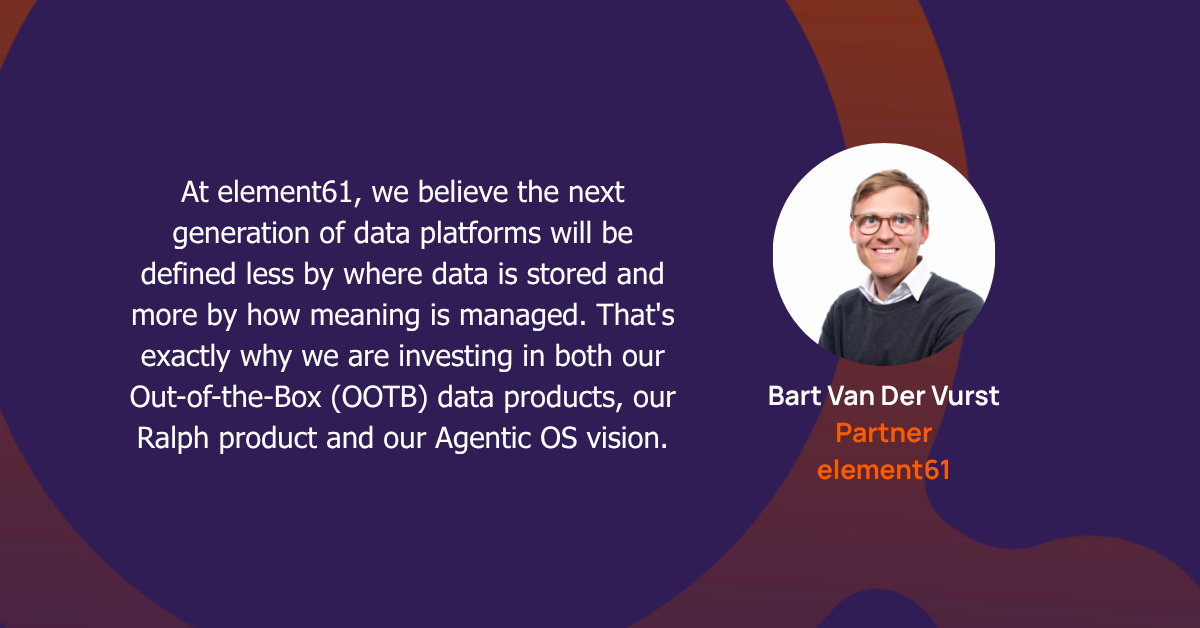
Out-of-the-Box provides trusted, governed business data products that establish a common understanding of key business concepts. Agentic OS builds on top of that foundation, enabling AI agents to consume those data products, understand their context, and act with confidence.
Together, they bridge the gap between raw data and trusted AI outcomes.
Because in an AI-driven world, the challenge is no longer connecting systems: The challenge is ensuring every agent understands your business the same way your people do.
Ready to advise & help you in this!
FAQ
No, we don't believe so. Connecting AI agents directly to systems such as Salesforce, SAP or ServiceNow through protocols like MCP solves access, but not the harder problems a data platform addresses: shared understanding, a trusted source of truth and performance. Access was never the hardest problem. What does change is the form: the data platform is evolving into the layer where meaning, context and governance come together for people and AI agents.
Direct access means connecting an AI tool straight to operational applications through protocols such as MCP or a CLI. Data stays where it was created, applications keep ownership of their information, and agents retrieve only what they need, when they need it, based on the user's authorisation. On paper this reduces data movement, replication and infrastructure. In our view, however, it solves access only, not understanding, source of truth or performance.
Having access to information is fundamentally different from understanding what it means. Ask an AI agent "How many active customers do we have?" and it may query Salesforce, an ERP, a marketing platform and a customer success tool, returning four different answers that are all technically correct. Each system applies its own definitions and business rules. What the agent lacks is context: which definition is authoritative and how to reconcile them.
We see the true contribution of a data platform as its ability to create a shared understanding of the business. Moving, storing and processing data matter, but they were never the real source of value. Over time, organisations embed definitions, business rules, ownership, governance, quality controls and trusted metrics into their platform. That often invisible layer beneath dashboards and reports lets teams align around the same version of reality.
We define an ontology as the way an organisation defines and connects its business concepts. It describes, for example, what a customer is, how a prospect becomes a customer, which systems hold customer information, which source is authoritative and how entities relate to one another. An ontology acts as the connective tissue between data, systems, processes and business concepts, creating understanding without necessarily consolidating all data into a single platform.
Because every organisation's ontology is unique. No vendor can define what a customer means in your company, which process variations matter, which metrics drive decisions, or which exceptions have built up over years of operating the business. Your ontology is your company's intellectual property: a digital blueprint of how your organisation actually works. Vendors supply the tooling; the business meaning must come from you. element61 can help you shape it.
Many technology vendors are reaching the same conclusion. Microsoft is investing heavily in semantic models and business knowledge layers, its IQ layers. Databricks increasingly focuses on governance, business semantics and unified understanding across data products. Across the industry, the conversation is shifting from data itself towards meaning. We believe this is exactly the right direction, provided organisations keep ownership of their own business definitions.
It depends on the definition. If a data platform means a centralised environment where all data must physically reside before it can be used, that model is clearly evolving through federation, virtualisation and AI-driven access patterns. If it means the place where meaning, context, governance, trust and business understanding come together, its importance is only increasing. We may simply stop calling it a data platform.
We expect the future to look more like a semantic platform: an ontology layer, a business knowledge platform or a context layer that sits above distributed systems and gives both humans and AI agents a shared understanding. People don't ask questions because they want access to data; they ask because they want trustworthy answers. Somewhere between access and trust, this new kind of platform is emerging.
We believe the next generation of data platforms will be defined less by where data is stored and more by how meaning is managed. That is why we invest in our Out-of-the-Box (OOTB) data products, our Ralph product and our Agentic OS vision. OOTB delivers trusted, governed business data products; Agentic OS lets AI agents consume them with context and confidence. Get in touch via the 'Contact us' button.
We recommend starting with meaning rather than connectivity: agree on key business definitions such as an active customer, decide which source is authoritative for each concept and map how entities relate across systems like Salesforce, SAP and SharePoint. That shared ontology ensures every AI agent understands your business the same way your people do. Our team is ready to advise and help; reach out to us via the 'Contact us' button.
